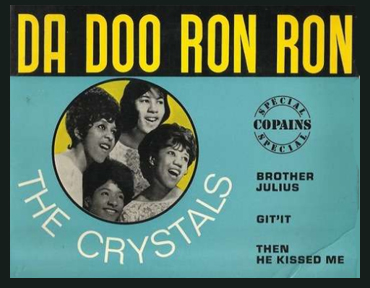
 The Crystals
biography
The Crystals
biography
Among aficionados of the girl group sound, there can't be five acts more
beloved than the Crystals. Their best-known songs, which include
"He's a Rebel," "Uptown," "Da Doo Ron Ron,"
"Then He Kissed Me," and "There's No Other Like My Baby,"
are among the finest examples of the best that American rock & roll had to
offer in the period before the British Invasion.
The group was originally a
quintet consisting of Barbara Alston (born 1945), Dee Dee Kennibrew (born
1945), Mary Thomas (born 1946), Patricia Wright, and Myrna Gerrard, organized by Benny Wells while they were still in
high school. All of whom had started out singing in churches; Barbara
Alston was Wells' niece, and although she later became known as their lead
singer on many of their records, Alston was actually recruited as a
backup singer by her uncle. Under Wells' guidance, they began performing in
more of a pop vein, and one of the gigs that they got was cutting demos for the
publisher Hill & Range, which brought them to the Brill Building in midtown
Manhattan. It was there, while they were rehearsing, that they chanced to be
heard by Phil Spector, who at that time was just starting up his own
label, Philles Records. He was in the market for new talent and the
Crystals -- who, by that time, had lost Gerrard and added La La
Brooks to their lineup as lead singer -- were just what he was looking
for, sort of. He liked their sound and their range, but he didn't initially
like Brooks' voice and insisted on Alston taking the lead,
somewhat reluctantly on her part.
In September of 1961, the slightly reconfigured group cut their first
hit, "There's No Other Like My Baby," which
rose to number 20 nationally. It was a promising beginning, putting the
group, Spector, and his new label on the map; although another song cut at
about the same time, "Oh, Yeah, Maybe, Baby" (which
featured Patricia Wright on lead), pointed the way to the group's
future, with its understated yet boldly played string accompaniment.
In early 1962, the Crystals recorded "Uptown,"
Barbara Alston's strong-yet-sensuous vocals enunciated lyrics that were as
steeped in topical subject matter, especially about the frustrations of life in
the ghetto. "Uptown"
reached number 13
nationally.
It was at this point, in the wake of "Uptown," that the
history of the Crystals gets a little more complicated. It wasn't
until June of 1962 that they had another single ready to go, and it engendered
all kinds of problems that "Uptown" had avoided. If that song had
gotten a serious lyric across with an elegant and quietly passionate setting,
"He Hit Me (It Felt Like a Kiss)" was the reverse, presenting a
disturbing lyric about infidelity and the physical abuse of a woman by a man,
in a dark, ominous manner. Barbara Alston and company gave it
everything they had, and Spector came up with a surprisingly subtle,
bolero-like arrangement, but it was a lost cause. Radio stations simply
wouldn't play it.
The following month, Spector was back in the studio running another Crystals session,
except that this time it wasn't really the Crystals that he was
recording, but Darlene Love. As the owner of the Crystals' name and,
as their producer, possessing the right to record anyone he wanted (or anything
he wanted) and label it as being from "the Crystals," he decided to
forego any further battles over who should sing lead, and forego using the
group entirely for "He's a Rebel." A celebration of street-level
machismo like no other, it was an upbeat number with gorgeous hooks and, with
none of the baggage of its failed predecessor, became a number one hit, as well
as engraining itself in pop culture history as a quintessential girl group
classic. Darlene Love was the lead singer on the next hit by
"the Crystals," "He's Sure the Boy I Love," as well.
It wasn't until early 1963 that the group again sang on one of their own
records, "Da Doo Ron Ron,"
and by that time, Spector had accepted La La
Brooks in lieu of Alston as lead singer. That record rose to
number three in America and became their second biggest British hit, reaching
the number five spot in the U.K. "Then He Kissed Me" then reached No
2 in the UK and No 6 in the USA.
The Crystals were in a seemingly enviable position, except for the fact
that they and Spector were increasingly at odds over what he was
doing with them. They'd been unhappy from the time when Spector began
using their name on behalf of records made by Darlene Love, and every time
they were obliged to perform those songs on-stage it grated against them, and
in 1963 they were almost constantly touring and performing. By 1964, they also
perceived Spector's growing inattention; he had lately discovered a girl
trio called the Ronettes on whose music and lead
singer, Veronica Bennett, he was lavishing ever more of his time and
energy. Meanwhile, the Crystals were making good and interesting
songs, such as the beautiful "Another Country, Another World,"
"Please Hurt Me," and "Look in My Eyes," the latter a
bluesy ballad that showed a side of their sound that Spector seldom
tried to explore.
Finally, in 1965 the Crystals bought out their contract and headed to
the seemingly greener pastures of the Imperial label, where they found no
success; by that time, the only girl groups that were still competitive in the music
marketplace were associated with Motown.
By 1966, the Crystals had disbanded, and for five years no one
heard anything about the group except in airplay on oldies
stations. Spector had even closed down Philles Records, and the
resulting unavailability of their records except on the radio only raised the
value of the old copies that were out there, and made his periodic reissues of
the group's work that much more prized by fans.
Then, in 1971, with the rock & roll revival in full swing, the group
members reunited and spent a few years delighting audiences on the oldies
circuit. Various incarnations of the group resurfaced every so often in the
late '70s and 1980s, but at the dawn of the 21st century, Dee Dee
Kennibrew was still leading a version of the group and had even managed to
get them recorded.